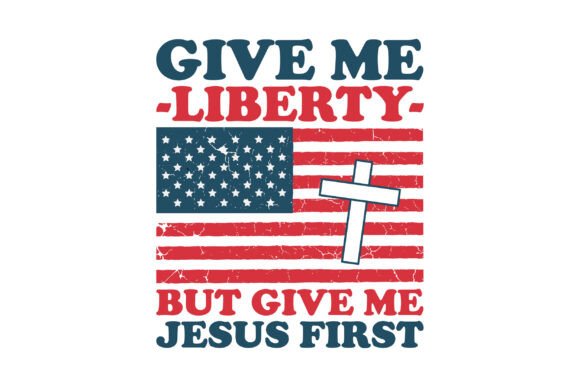
Give Me Liberty but Give Me Jesus First
A Design That Speaks Before the Needle Moves
First glance at Give Me Liberty but Give Me Jesus First tells you it’s not just typography—it’s a statement with rhythm, reverence, and quiet confidence. The phrase flows left to right like a spoken vow, not a slogan. There’s no excessive ornamentation: no eagles, no stars-and-stripes flourishes, no cross silhouettes competing for attention. Instead, clean, confident lettering—slightly serifed but grounded—carries weight without stiffness. It feels handmade in spirit, even as a digital embroidery file. I immediately pictured it stitched onto a natural linen tote bag for a church bazaar: earthy fabric, soft thread contrast, and a message that lands gently but memorably.
Fits Like a Well-Worn Phrase—Not a Trend
This isn’t a design chasing virality. It’s built for longevity—and that shows up in real project use. As a machine embroidery design, Give Me Liberty but Give Me Jesus First holds up across several common applications: sweatshirt embroidery (especially on midweight cotton blends), embroidered patches for denim jackets or ministry volunteers’ caps, baby embroidery on organic cotton onesies (when sized down thoughtfully), and pillow covers for nursery decor or pastoral gifts. Its linear layout makes it forgiving on curved surfaces like structured caps—no awkward letter warping if hooped carefully. On tea towels or aprons? Yes—especially when paired with simple running-stitch borders or minimal fill-stitch backing for texture without bulk.
Where It Shines—and Where You’ll Want to Pause
Give Me Liberty but Give Me Jesus First thrives on stable, medium-weight fabrics: 100% cotton tees, twill tote bags, brushed poly-cotton sweatshirts, and quilting-weight linen. It’s less ideal for ultra-thin fabrics (like lightweight rayon or sheer voile) where dense satin stitch lettering could pucker or show through. On stretchy knits—think performance tees or ribbed baby bodysuits—you’ll need cutaway stabilizer and possibly reduced stitch density in the lettering to avoid distortion. Dark fabric? Absolutely works—but test thread colors first: creamy ecru or warm charcoal reads with dignity, while stark white can feel clinical unless balanced with tone-on-tone backing.
Small hoop sizes (under 4” width) demand caution. The full phrase is long—so for caps or baby hats, consider using just “Give Me Jesus First” as a cropped variant (if your license permits editing). Tiny corners? No fine decorative accents or tight scrollwork here—so no risk of lost detail in tight curves. But do inspect the lowercase “j” and “g”: those descenders need breathing room. If stitching on layered garments (like a flannel shirt over thermal), add extra stabilizer underneath—not just on top—to keep letter clarity intact after washing.
What It Adds to Your Finished Product—Beyond the Thread
When stitched well, Give Me Liberty but Give Me Jesus First elevates perceived value—not by flash, but by intention. Customers notice craftsmanship in legibility, consistent stitch tension, and thoughtful placement. It builds trust: this isn’t mass-produced irony; it’s a sincere, well-executed message. For Etsy sellers and small shop owners, that sincerity translates into repeat buyers and word-of-mouth referrals—especially among faith-based communities, homeschool co-ops, and church supply boutiques. As a personalized gift or custom apparel piece, it feels curated, not generic. And because it avoids visual clutter, it photographs cleanly in printable mockups—critical for digital product previews and social media listings.
Practical Designer Notes You’ll Actually Use
- Always test on scrap fabric first—especially if combining with other elements (e.g., a small cross icon or banner accent). See how the letter spacing holds up after washing.
- Check thread color contrast across both light and dark backgrounds. A single thread palette rarely works equally well on ivory and navy.
- Review stitch density. Overly dense satin stitches on long phrases can cause fabric stiffening—consider slight underlay reduction if your machine allows.
- Confirm hoop size compatibility before digitizing or resizing. Some versions may be optimized for 5x7 hoops; others stretch wider.
- Inspect small details at actual stitch-out scale—not just on screen. Those subtle serifs matter more than they look in vector preview.
- Test black-and-white mockups to assess readability at distance—vital for tote bags or boutique signage.
- Use proper stabilizer: tear-away for stable wovens, cutaway for knits or textured fabrics like terry cloth towels.
- Verify licensing before selling finished items or listing the digital embroidery file. Does it allow commercial embroidery, resale of physical goods, or redistribution as design assets?
Final Thought: A Quiet Anchor in a Noisy Marketplace
In a sea of fast-turnaround T-Shirt Designs, Give Me Liberty but Give Me Jesus First stands apart—not by shouting louder, but by holding space. It’s not for every project, and that’s its strength. Used intentionally—with care for fabric, stabilizer, thread, and context—it becomes more than decoration. It becomes a quiet affirmation stitched into daily life: on a mom’s apron while she cooks Sunday dinner, on a teen’s backpack heading to youth group, on a pastor’s gift pillow for retirement. That kind of resonance doesn’t come from trend-chasing. It comes from knowing exactly what the design is—and isn’t—meant to do. And for craft business owners, Etsy sellers, and makers who value meaning as much as method, that’s worth every stitch.